AI Readiness: Why Only a Few Companies Are Turning AI into Real Business Value
Understanding AI Readiness in 2025
Some of the links on this website are affiliate links, meaning we may receive a commission if you choose to make a purchase. Please review our Affiliate Disclosure for more information.
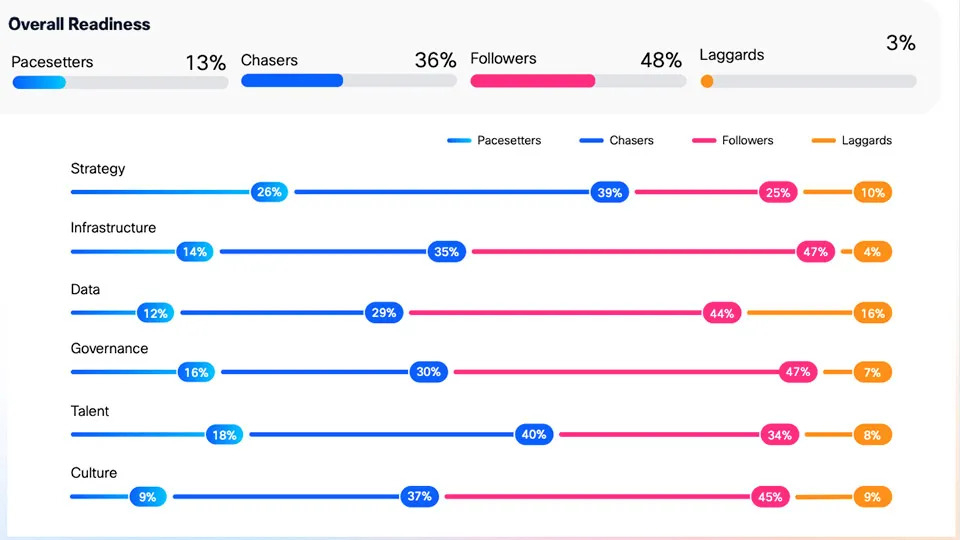
AI readiness is fast becoming the defining factor separating future winners from laggards in the digital economy. According to Cisco’s latest AI Readiness Index (2025), just 13% of companies are fully prepared to operationalize AI. This number hasn’t changed much year over year — but the context has.
A small but disciplined group of organizations, dubbed “Pacesetters”, are now demonstrating that real business value is possible when AI readiness is treated as a strategic capability. These firms are turning AI pilots into production systems that generate measurable ROI — often three times higher productivity and 1.5x profitability compared to their peers.
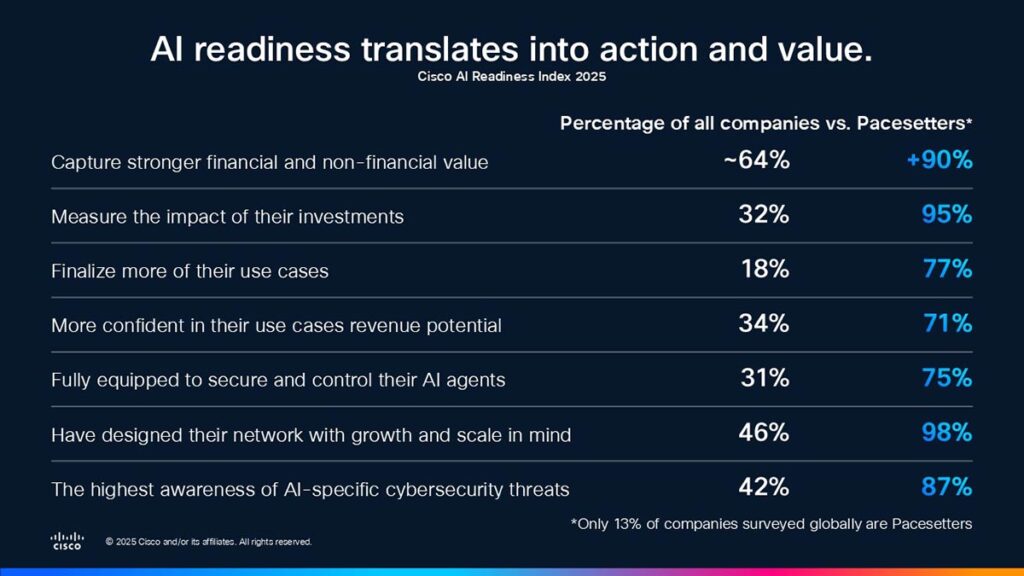
For most businesses — especially SMEs — this finding highlights a crucial point: AI isn’t about tools alone. It’s about readiness, structure, and culture. Without the right foundations, even the most powerful technology won’t deliver lasting impact. See also the OECD.AI: Policies, data and analysis for trustworthy artificial intelligence.
AI Readiness and the Rise of the ‘Pacesetters’
Cisco’s research divides companies into four levels of AI readiness: Pacesetters, Chasers, Followers, and Laggards. Nearly half (48%) are still Followers — watching from the sidelines — while 36% are Chasers, actively experimenting. Only 13% of firms qualify as Pacesetters: organizations that have turned experimentation into execution.
These Pacesetters share some common traits:
- Disciplined AI strategy with clear business outcomes
- Robust infrastructure that scales data and computing power
- Strong governance around ethics, data quality, and compliance
- Cross-functional talent blending IT, data science, and business
- Adaptive culture where teams learn and iterate fast
For SMEs, this model provides a roadmap. The key takeaway? Don’t start with “Which AI tool should I use?” — start with “What business process could AI transform?” Once you have clarity on that, execution becomes far easier using flexible tools like Make.com to automate workflows or systeme.io to streamline customer operations and digital funnels.
AI Readiness and the Infrastructure Gap
Another insight from Cisco’s research is the rise of AI infrastructure debt — the cumulative effect of weak systems, outdated data practices, and under-investment in scalable technology.
Companies eager to adopt AI often rush deployment without upgrading data pipelines or network capacity. The result? Projects that stall, costs that spiral, and teams that lose faith in AI’s promise.
AI readiness means fixing the foundations first. SMEs can learn from this by investing early in:
- Centralized, clean data for training and analysis
- Cloud-based automation platforms like Make.com to connect systems and reduce manual effort
- AI content and training tools such as Deepbrain.ai to develop virtual presenters or learning assets for employees
- Flexible CRM and operations systems built on low-code solutions such as Systeme.io
These tools help smaller firms punch above their weight — building “AI-ready” processes without hiring large teams of engineers.
AI Readiness and the Age of AI Agents
A major new development in the 2025 Index is the rise of AI agents — autonomous software entities that can perform tasks, make decisions, and collaborate with human teams.
Cisco found that 83% of companies plan to use AI agents, with many expecting to have hybrid workforces (human + bot) within a year. However, more than half admit they lack the infrastructure to support this shift.
For SMEs, this presents both a challenge and a once-in-a-generation opportunity. AI agents can handle repetitive admin, customer communication, and even basic coding — freeing people to focus on higher-value work. Using platforms like Deepbrain.ai, smaller businesses can already create digital avatars or video presenters to automate customer engagement or training content.
The trick lies in balance: automation that amplifies human capability, not replaces it. That’s what true AI readiness means — blending people, process, and technology into a coherent system.
Readiness Is the New Differentiator
From a business strategy perspective, AI readiness is no longer optional; it’s existential. The Pacesetters aren’t just early adopters — they’re disciplined executors. They understand that value comes from systematic integration, not scattered experiments.
This is especially relevant as companies face pressure to prove ROI. Eight in ten firms now report heightened expectations to demonstrate tangible returns on AI investment. That means the winners will be those who can measure, track, and iterate their AI projects — something tools like Make.com make much easier by connecting marketing, sales, and data systems without costly IT integration.
AI readiness therefore represents a new kind of corporate fitness test: how efficiently can you turn ideas into outcomes?
How SMEs Can Become AI Ready
As someone working closely with SMEs, I see enormous potential here. Many small and mid-sized businesses underestimate how close they already are to achieving AI readiness.
By leveraging accessible automation (via Make.com), scalable marketing systems (Systeme.io), and AI-driven video tools (Deepbrain.ai), SMEs can move from experimentation to execution quickly — without massive capital expenditure.
The lesson from Cisco’s Pacesetters is simple:
AI success isn’t about having the biggest budget — it’s about having the strongest readiness mindset.
That means preparing data, clarifying goals, involving your people, and choosing the right platforms to turn ideas into results.
In short, the future belongs to the AI ready.
💡 Ready to Take the First Step Toward AI Readiness?
Don’t just read about AI transformation — start building it.
👉 Download our free guide: AI Automation Quick Start to discover simple, actionable steps to make your business AI ready in days, not months.
This practical guide covers how to identify your top automation opportunities.
Select the right tools (including Make.com, Systeme.io, and Deepbrain.ai), and kick off your first AI-driven workflow confidently.
Start small. Scale fast. Get AI ready today.